Showing posts with label Concert and Performance Reviews. Show all posts

Monday, November 19, 2012

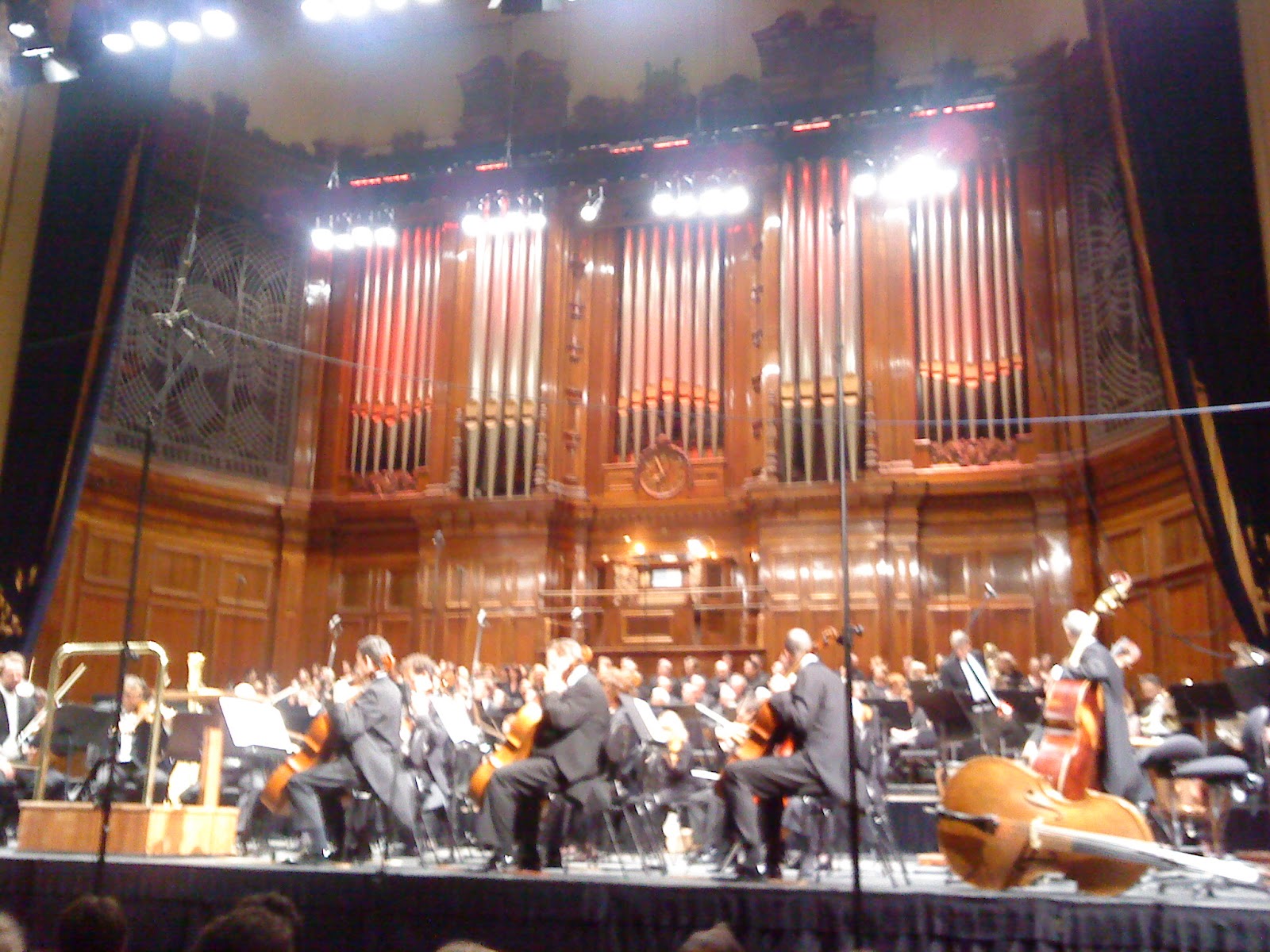
Melbourne Symphony Orchestra and Chorus - Brahms Piano Concerto No.1 and Duruflé Requiem

From http://www.mso.com.au/whats-on/2012/durufle-requiem/:
Saturday 17 November at 8:00pm (Event Duration: 2hrs)
The Arts Centre Melbourne, Hamer Hall

Tadaaki Otaka conductor
Garrick Ohlsson piano
Deborah Humble mezzo-soprano
José Carbó baritone
Melbourne Symphony Orchestra and Chorus

Johannes Brahms Piano Concerto No.1
Maurice Duruflé Requiem

The Requiem by French composer Maurice Duruflé is a work of delicate and moving beauty, and this performance features two of the most eloquent of Australia’s fine singers, to help draw you into the work’s lush, meditative world. The program begins with Brahms’ towering First Piano Concerto, in which orchestra and soloist unite to create one of the grand statements of the Romantic spirit.

The MSO provided free of charge a wonderful set of program notes covering several concerts: "MSO in Concert October-November 2012".

Rather than replicate what is written in the program notes, I have provided my own contemporaneous impressions of the performance.

Brhams: Piano Concerto No.1 in D minor, Op.15
1. Maestoso
The notes indicate that the Brahms Piano Concerto had a difficult gestation.It begins with a dramatic "sturm und drang" opening followed by an elegaic theme and a section of intense counterpoint within the orchestra. With the introduction of the piano the excitement builds, with the piano being gently accompanied by the orchestra. A section for solo piano starts off somewhat like a set of keyboard exercises. The following music for the flutes and woodwinds has a lilting pastoral quality and the strings are lush and romantic. Later a solo horn plaintively calls in the background in a duet with the piano. The theme of the virtuosic piano exercises continues, punctuated by the orchestra. The strings are the heart and soul of the first movement, with passionate interjections from the piano and gentle solos from the flutes, woodwinds and brass. The gentleman playing the drums was kept busy! A recurring leitmotif is tossed around by the piano and orchestra, and at one point there is a bit of an "Hungarian Dances" gypsy feel. The keyboard exercises recur with variations on a theme. Overall, this movement has the feel of a chamber music piece 'writ large'.

2. Adagio
The second movement starts gently with a calm and stately orchestral introduction and then the piano enters alone. A duet (not unlike a love song) between the orchestra and piano follows. The subsequent piano solo has a bit of a "cool jazz" feel to it. It is as if the piano is wondering, wandering ... The orchestra returns more emphatically and the duet continues, led at times by different orchestral voices. The listener is kept occupied with changes in harmonic direction, voices and volume. It is a movement that seems a little unsure of itself and where it is going. Eventually the piano rises triumphantly over the texture. The writing seems workmanlike rather than inspired. In a couple of places the orchestra was playing almost painfully 'pianissimo'. The piano was played here with expression, love and regard, and the movement finishes with a very romantic cadence.

3. Rondo (Allegro non troppo)
The final movement begins with passion and drive, and its core theme is tossed back and forth. It is as if the piano (a sleeping giant) has awoken, and the orchestra is playfully dancing around it. There are powerful statements by the brass. In contrast to the Adagio, this movement is tight, exciting and well-written. It heads off in a different direction in the centre of the movement, and there is a fugal interlude in the strings. The main theme returns, followed by somewhat of an orchestral "sunrise" playfully dancing amongst the orchestral parts. There is a distant brass "call to arms" (with a bit of a 'film score moment') and the movement builds to its conclusion.

Tadaaki Otaka is a joy to watch, and Garrick Ohlsson was most impressive, playing from memory. He is a large man, with impressively large hands, but he played with sensitivity, flair and obvious technical competence. After a rapturous reception, he was kind enough to return for an encore - Chopin's Waltz No.7 in C# minor, Op.64,2. This was played beautifully, with a lilting soft touch, class and sensitivity.

Duruflé: Requiem
There appeared to be 104 singers in the MSO Chorus, and unusually they were 'mixed up' on stage, rather than being grouped together in individual parts. I am not sure that this worked from the perspective of the spectacle, as it provided a more homogenised and diffuse sound and you could not "see" (aurally) the sound move from part to part, and at times it was difficult to work out exactly which part was singing without the visual cues. The tone of the women was reasonably pure but unmistakably warm and feminine.

At the start of the piece there was a lovely lush and warm tone in the strings. The Domine Jesu Christe had an 'edgy' quality, being populated by the lower orchestral and choral parts. There was a colourful use of brass, percussion and piccolo flute. The Hostias featured a baritone solo, woodwinds and scrubbing strings. The Sanctus had a nice feel and dynamics and an exciting climax at the Hosanna.

The Pie Jesu, featuring a mezzo-soprano solo, violas and cellos was warm and rapturously embracing, and the organ made an appearance.

This led to a "Where's Wally?" moment, as I rapidly processed that there no longer seemed to be a pipe organ in the concert hall and (shock, horror!!!) they were using an electronic organ on stage. Yes, we have a world-class concert hall but no pipe organ in it. What a tragedy! Many people would have known that the previous organ was both unsuitable and inadequate for a modern concert hall, but it seems amazingly short-sighted that the renovation of Hamer Hall did not include the installation of a world-class concert organ. Shame, Melbourne, shame!

The chant-like opening of the Agnus Dei was followed by a soaring romantic motif in the strings, and the male members of the chorus sang with a warm rich tone.

The Lux aeterna seemed like dappled sunlight on the garden. There was a lot of orchestral colour provided by the flutes and woodwinds.

In the Libera me we were confronted by growling brass and there was an exciting choral and orchestral climax with the baritone soloist.

The In paradisum finished the work gently with the harp, horns, women and strings.

The Chorus acquitted itself well, with good tuning, coordination, cut-offs and diction.

Sadly the soloists (baritone in the Domine Jesu Christe and Libera me and mezzo-soprano in the Pie Jesu) were somewhat 'drowned out' by the orchestra, and at the end of the Pie Jesu it was not possible to hear Deborah Humble at all - her lips were moving but ... However, she did cut a splendid figure sartorially, resplendent in a Grecian-style midnight blue satin robe.

The Duruflé Requiem is inevitably compared with that written by his fellow Frenchman, Gabriel Fauré. I have sung both, but must admit to a preference for the Fauré. The Duruflé seems too painfully understated and shy, as if it never breaks free of its own straight-jacket. It is interesting that Chorus Master Jonathan Grieves- Smith writes about this very conundrum and tension between its beauty and its timidity in his program notes.

The performance was very well received by the audience on all counts and the effort put into preparation by all concerned paid handsome dividends.


Monday, November 5, 2012

Melbourne Symphony Orchestra plays the "West Side Story" score

On Saturday 20 October I had the privilege of hearing the MSO accompany the original "West Side Story" film in the newly renovated Hamer Hall.


Originally a musical by Stephen Sondheim (lyrics) and Leonard Bernstein (music), the 1961 film starring Natalie Wood, Richard Beymer, Russ Tamblyn, Rita Moreno, George Chakaris and Tucker Smith went on to win ten Academy Awards, including Best Motion Picture. The spoken words and vocal tracks were preserved on the film, whilst the orchestra provided all the accompaniment. Interestingly all of Natalie Wood's songs were dubbed by Marni Nixon, as were some of the songs by Rita Moreno.

The 'new' Hamer Hall is visually stunning, with a warm orange and ochre theme and wooden-backed seats with orange velvet cushioning. Cylindrical pendulum lights hang from the ceiling like tongues of flame. They reminded me of large luminous 'lava lamps' with shiny metallic tips.

The size of the orchestra was also visually impressive, virtually filling the whole stage, with a big and bold brass and percussion presence and oh so lush strings. There was also a harp used in places in the score. The music itself is confident, colourful and sassy and there is liberal use of a latin beat.

It is an amazing exercise in logistics to pull off a coordinated enterprise of this nature, and the conductor had a video screen displaying the film in real time (which was regularly punctuated by coloured 'bar lines' - signficance unknown) in front of him in addition to the orchestral score.

I was immediately struck by the vivid and somewhat unnatural colourisation of the original film and the amount of make-up worn by the actors! The choreography by Jerome Robbins is simply brilliant and there is a lot of very sharp dancing and some wonderful fluffy and flouncy dance costumes for the female leads. Aside from the dark undertones of the clashing gangs and the inherent racial intolerance that spawned their differences, there is also a chilling element of police brutality and threats.

In this modern-day version of 'Romeo and Juliet', things do not end well for the young lovers (as in the traditional story). It caused me to think that over the fifty years since the film was made, sadly very little has changed in terms of all humanity managing to live together in peaceful coexistence. We are lucky here in Australia to have a relatively tolerant multi-cultural society, but there are certainly many other places in the world that are hotbeds of intolerance, whether in regard to gender or race or religious beliefs.

But I digress ... The orchestra was simply fabulous, and the combination of the film and the 'surround sound' swirling about you served to draw you into the story in a more intense way than sitting in a cinema.

The MSO, conductor and the no doubt large technical team are to be congratulated on a very successful outcome. I understand that the MSO now performs film scores 'live' several times a year, and based on this performance, this is something not to be missed if one of your favourite films is given the star treatment.

www.mso.com.au
More about "West Side Story": http://en.wikipedia.org/wiki/West_Side_Story

Thursday, July 26, 2012

Melbourne Symphony Orchestra 2012 Season - Music of Maurice Ravel

Melbourne Symphony Orchestra 2012 Season
Saturday 21 July 2012 at 8pm
Melbourne Town Hall
(Approximately 2 hours)

Tadaaki Otaka, conductor
Katarina Karneus, mezzo-soprano
Jean-Efflam Bavouzet, piano

Program of music by Maurice Ravel (1875-1937)
Daphnis and Chloe: Suite No.2
Ravel: Sheherazade
Interval
Piano Concerto in G
Bolero

This was a rare opportunity to hear four of Ravel's works on the same program, occasioned by the MSO's special offer (advertised in "The Age" newspaper) of "Three Concerts for A$99, an offer too good to pass up.


Our seats were in the second-back row of the balcony, which had a clear view of the stage. It appeared that the concert was all but sold-out, as there was only a handful of vacant seats. Free programs were once again available.


The first piece, Daphnis and Chloe: Suite No.2 had an unmistakeable French impressionist feel about it. Not having read the program at this point, the opening section reminded me a lot of gently lapping waves and Debussy's La Mer. It continued on in a similar vein for a while, at times sounding more pastoral or alternately very much like a broad sweeping film score in the Casablanca genre - you could almost see a touching scene between Humphrey Bogart and Ingrid Bergman! Towards the end of the piece the music became much more agitated, sounding like a storm that had blown in, and finished in this mode. Otaka is a very elegant conductor to watch, and he managed to bring out the best in terms of the well-crafted musicianship of the orchestra.

Swedish mezzo-soprano Katarina Karneus acquitted herself well with the three songs of Sheherazade. She was a resplendent figure in stage in a cardinal red gown, but perhaps the choice of a halter-neck and a clinched waist with jewelled buckle was not the most suitable for her body-type. For most of the performance the orchestra provided an appropriate level of accompaniment but at times she was a little "drowned out". This was a charming and pleasant piece which well showcases the skills of the soloist.


The highlight of the program was probably the Piano Concerto in G, with soloist Jean-Efflam Bavouzet, who played with extraordinary energy and panache. There are obvious jazz and blues elements included in the score, including the influence of Gershwin's Rhapsody in Blue. This is an exciting piece which was executed well by both orchestra and soloist, and was very enthusiastically applauded by the audience. As an interesting aside, Bavouzet also has a Scandinavian link - he is the Artistic Director of the Lofoten Piano Festival in Norway. This simply fabulous group of islands is well worth a visit!

During the break between the two final pieces I ran foul of an usher whilst attempting to take one final non-flash photograph for this blog posting. I was told that there was no photography allowed during the performance, and when I countered that I was not taking photos during the performance, I was told that the break was also part of the performance! There is no signage in the Town Hall pointing this out to patrons nor any mention of it in the program or on the web site. I was upset by this, as I only wanted the photo to help promote the orchestra, and there is no way that a non-flash photo in the second-back row of the auditorium respectfully taken during the break would have been capable of distracting anyone. So, I put my camera away 'sans photo' but to make matters worse the usher sat right behind me breathing down my neck for the Bolero to make sure that I did not transgress. As a result, I was the one who was distracted and was no longer "in the zone" and able to enjoy the music to the same extent. It is one of those curiously unsettling human 'sixth senses' when you know someone is staring at you from behind. As a result, I dared not move a muscle lest it was misconstrued as a movement towards my bag and the offending camera.

The audience loved the performance, and Robert Clarke on the snare drum, appropriately placed centre stage, capably and consistently provided the rhythmic drive for the piece. I don't think that I ever saw the movie "10" with Bo Derek that made the Bolero somewhat infamous, and it is probably a good thing that it is now so long ago that many people would not be aware of this association. It was good to see the piece played as it was intended by a high-calibre ensemble, and to to hear the way that the theme colourfully swirls around the orchestra, all the time grounded by the incessant beat of the drum. It is a very clever piece whilst being quite primal at the same time, and it is not hard to understand its popularity.

Monday, July 16, 2012

Review - "Moonshadow" the Musical

Currently playing at the Princess Theatre, Melbourne
http://www.moonshadowthemusical.com.au/

When I was a teenager I enjoyed the music of Cat Stevens, and was somewhat dismayed when he became Yusuf Islam and left his musical career behind. In recent years he has become just "Yusuf" and resumed his life as a performer in various ways. I was somewhat sceptical when, together with his co-writers he developed the musical "Moonshadow" as a 'feel-good' story showcasing the music of Cat Stevens. I had originally decided not to attend, but was offered a ticket as a birthday present. In the end I felt badly disappointed and wished that I had not accepted this kind offer.

I must preface this review by stating 'up front' that I am not a big fan of musicals, so they have to be truly exceptional for me to enjoy them. As someone who is a choral performer, I generally get a lot more pleasure from performing than sitting still and listening.

"Moonshadow" is decribed as "a life-long dream of its producer, Cat Stevens" which weaves forty of his songs (old and new) in some way into the production. It is a "magical story with themes that are both powerful and universal. It is about hopes and dreams, greed and power, right and wrong, but most importantly Moonshadow is about finding happiness and love".

The young performers playing the key roles of Lisa, Stormy and Patrick did an excellent job. For me Patrick was the stand-out performer, with a great voice and charisma and stand-out moves. He doesn't get the girl in the end but I felt that he deserved to!

The parents of Lisa and Stormy were also sensitively portrayed by older performers and were quite believable.

The sets, costuming and stage management were well done. It is interesting with the costuming that there are women and men with both covered and uncovered heads, and I wonder if this was a cultural tribute. There was a live band in the orchestra pit, but I felt a lot of the time the bass aspect predominated. The whole show started with a very strange synthesiser introduction. One thing that really 'bugs me' is that so many Australian performers insist on singing with an American accent rather than a more neutral accent. It grates, like fingers on a blackboard (a concept which is perhaps unfamiliar to a whole generation!).

Off-stage at various times we see the black and white "good shadows" (one of whom has a long white beard, looking not unlike Yusuf himself), and Moonshadow is sent as their emissary to Stormy, 'the chosen one', to assist him on his journey to rid the world of darkness. Moonshadow was perhaps the greatest disappointment. In short, despite being on stilts and towering over everyone else, he was a 'wimp', with insufficient persuasive powers over Stormy, who for most of the production is a "boy behaving badly".

In terms of the synopsis, parts of which are surely an allegory for Yusuf's own journey through life, we are introduced to a world where darkness is the norm and daylight is just a memory (not unlike the Norse 'Age of Ragnarok' where the wolf has swallowed the sun). Lisa and Stormy (who bears an uncanny resemblance to Julian Assange with a shock of white hair) were childhood sweethearts, and Stormy has a dream of finding the light and bringing it back to the world. He gives a picture of a tree bathed in golden light to Lisa, and she gives him a pendant worn by her late mother. They both promise to stay true to the dream. While Stormy remains in town, Lisa is sent away by her father to live with her aunt. She only returns after her aunt's death, and Stormy is reminded of his feelings for her, but Lisa's father has plans for her to marry Patrick, the son of Mr Matthew ("Matthew and Son").

For some unknown reason, although they live across the street from each other, Lisa's father and Stormy's father have developed a dislike for each other (although the two mothers were secretly friends). Mr Matthew seems to be the only one in town with any money, and Stormy's father derives their living by selling coffee and coffee beans. This is one of the humourous aspects of the production.

After Moonshadow appears to Stormy and informs him of his destiny as 'the chosen one', Stormy decides that "I know I have to go" and sets off on a journey of redemption to try to find the light. We are given the impression that this is a quest with a higher purpose, not unlike the search for the Holy Grail. However, Stormy is no Frodo, and things go downhill from here. The production wanders aimlessly over the next few scenes. Stormy finds a market in the country, ends up playing the guitar to an enthusiastic audience but shortly after Moonshadow essentially says "quit while you are ahead", someone gets robbed, the crowd blames Stormy, he gets beaten up and gets taken to the "House of the Half-Dead". With Moonshadow's help (after a quick prayer, perhaps another personal inclusion for Yusuf) he escapes, and then wanders off into a forest, where he encounters the evil Princess Zeena, who promises him what he has always been dreaming of.

At this point he conveniently forgets about those he has left behind - his parents and the love of his life, Lisa. A troupe of hippies wander along, and they seem to be on a bit of a 'trip', another clever allusion to the "sex, drugs and rock'n'roll" lifestyle of the 1970s. Stormy gets a new cloak, a new electric guitar and a lot of attention from the girls. Princess Zeena takes him to her home in the clouds, laughing all the way (and it is pretty clear that she has some barely-disguised evil intent). Interval arrives, and I am bored. I cannot see the point of the drawn-out previous few scenes, and feel disappointed that Stormy has been so quick to forget his mission and those that he loves.

After interval, the story is wrapped up with breath-taking speed. Moonshadow 'breaks the rules' and touches a mirror to try to help Stormy to "see himself". As a result, he begins to be visible to people other than just Stormy, incuding Zena. Before long, we see Stormy trapped in a cage, Zeena managing a factory that looks a lot like what we would expect Hell to be, and Moonshadow about to be extinguished by Zeena, who laughs maniacally, looking forward to stealing the last bit of light from the world. Mr Matthew also seems to be a collaborator.

Suddenly Stormy is free, running along a bridge with flames on either side. It was pretty unclear how this has happened, along with Moonshadow's reappearance. Stormy sees a vision of his future son, and somehow his reaction to this leads to the light being restored to the world. Then Stormy as 'the prodigal son' rides back into town, just as Lisa is about to be married to Patrick. In Stormy's absence Lisa's father and his father have resolved their differences.

The second-half of the plot seemed quite unsatisfactory, and was concluded with indecent haste. In the all-singing and dancing conclusion, Lisa and Stormy are reunited, light is returned to the world, and it seems that there is hope for the future for everyone. Even the jilted Patrick does not seem too unhappy. There is a touching cameo by the young Lisa and Stormy, singing "Morning has broken".

This is a production that promises so much but delivers so little. Although the music is timeless, the treatment of it was often not ideal and detracted from the enjoyment of familiar tunes. However, the greatest barrier to enjoyment is the gaping holes in the plot and to my mind Stormy did not do enough to redeem himself and at no point asks for forgiveness from those he betrayed. Patrick had worked hard to win Lisa's love, and obviously genuinely cares about her, but is instantly cast aside when Stormy returns. I felt empty at the end. It would have been much more meaningful (and genuine) to see Yusuf himself in concert.

I can't recommend it, but perhaps it would appeal to less-discerning young audiences or family groups. The musical was given its world premiere in Melbourne, so it will be interesting to see where it goes next.

A variety of souvenirs are available and are reasonably priced.

Wednesday, June 6, 2012

Melbourne Symphony Orchestra 2012 Season - Belshazzar's Feast

Friday 25 and Saturday 26 May at 8pm, Melbourne Town Hall
Bramwell Tovey: conductor and piano
Deborah Humble: mezzo-soprano
Jonathan Lemalu: bass-baritone
Melbourne Symphony Orchestra Chorus
Jonthan Grieves-Smith: chorus-master
www.mso.com.au

Britten - The Young Person's Guide to the Orchestra
Lambert - The Rio Grande
Walton - Belshazzar's Feast
Duration: 2 hours (including an interval of 20 minutes)


Through the good offices of a member of my choir who is also a member of the Melbourne Symphony Orchestra Chorus, I was able to attend this concert recently.

The Melbourne Town Hall is one of Melbourne's beloved icons, as is its grand concert organ. There was seating on the ground floor as well as on the balconies and the orchestra and chorus were seated on the stage. The chairs were surprisingly comfortable, with a goodly amount of padding and good back support, so I did not experience my customary amount of squirming when having to sit still in an uncomfortable seat for a long period. My only complaint would be that the chairs were bolted together with an inadequate amount of space for moderately sized people to sit 'shoulder to shoulder', so a certain amount of squirming became inevitable to avoid personal space encroachment! The cardinal red livery of the attendants was spectacularly attractive, and you really felt as if you were attending an event of importance. The men of the orchestra were wearing tails and (mostly) shiny black patent leather shoes, and the ladies were dressed in black.

Once I read the concert program (another surprise - this was free of charge and also available through the MSO website), I realised that the program choices had quite cleverly been put together. All three of the composers were contemporaries and it appears that Lambert and Walton had friends and muses in common through the Sitwell family. The program notes are truly excellent and well worth reading.

Britten's piece is based around a theme from the music of Henry Purcell (which should be well-known to most choristers and church-goers). The opening with the full orchestra was almost visceral, and generated strong emotions within me. A very large orchestra was assembled on stage, including six double-basses, and it was a joy to see and hear in a three-dimensional space the way that the theme was passed from section to section and the differing timbres of the instruments. At one point you cn almost hear a hornpipe being played, and yes, the theme is the Hornpipe from a suite composed by Purcell for the play Abdelazar (but also taken up elsewhere). The work concludes with a fugue and a powerful climax involving the full orchestra. Tovey's conducting was very animated and demonstrative, and at one stage he did a Napoleonic impersonation with one hand tucked into his jacket!

I do not recall having heard the Lambert piece before, and it very much reminded me of a film score, and at one stage it was highly reminiscent of the introduction to John William's "Star Wars" theme, and you almost expected to see Darth Vader stride onto the stage! There are plenty of jazz and blues references, and the piano part was very ably played by Tovey alongside his conducting. There was surprisingly little work for the mezzo-soprano soloist. Deborah Humble looked resplendent in a full-length gold lame gown and acquitted herself well vocally.

The highlight of the concert was Walton's "Belshazzar's Feast". The chorus was well-drilled with clear enunciation but was drowned out at times by the orchestra. Jonathan Lemalu was impressive, with a powerful voice and presence, and you could actually physically feel the vibrations from his voice. Tovey's conducting was frequently frenetic, and it did appear (from behind) to be difficult to follow his beat, but my choir colleague later explained that he adopts a technique of conducting by entry and line rather than globally. In any event, the orchestra and choir had it all worked out and combined to produce an excellent synergistic result. The string playing was tightly coordinated, both visually and aurally. The dramatic climax involved brass players on both balconies and the organist bringing the full power of the organ to bear on the final chord, after patiently waiting for what must have seemed like an eternity!

The enthusiastic applause of the audience went on for quite some time, reflecting the quality of the performances that had been delivered.

It was a marvellous concert, and I came away feeling both energised and entertained in the best possible way. There is no doubt that listening to a recording is no substitute for hearing and seeing an orchestra and chorus 'in the flesh', and I felt privileged to be there. If all the MSO's other offerings are of an equally high standard then Melbourne has a lot to be proud of.

Should we support live music at all levels? Absolutely! I love being a performer myself and it always gives you a 'warm inner glow' to have an appreciative audience after you know that you have given your best. Many academic papers have been written on the benefits of choral singing for good health (including both the immune system and mentally) and on the 'Mozart effect' for improving performance. Ironically as a performer I can find it hard to sit and listen to others as I would rather be 'doing', but with this concert it was a pleasure to sit transfixed and enjoy a sublime experience.

The Friday night concert was recorded and is available for streaming on the MSO website and will be broadcast on ABC Classic FM.

Not something you see every day on the way home on the train - a life-size teddy bear!

Sunday, April 10, 2011

Carl-Einar Häckner's Swedish Meatballs

Last night I was the fortunate recipient of a complimentary ticket to Carl-Einar Häckner's "Swedish Meatballs" one-man show at the Melbourne Comedy Festival.

I haven't laughed so much in a long time. It was an hour-long high-energy performance, combining music, magic, slapstick and a high degree of plain craziness. There was a liberal sprinkling of humourous Swedish references and Ikea featured prominently in the props, which also included a non-disappearing Houndini, barbequed birds, knives and fake blood and an Elvis-style bell-bottomed white jumpsuit, which looked 'fetching' (apparently a word for which there is no equivalent in Swedish) on the tall slim Swede with the wild eyes and shoulder-length blonde hair. He has quite a pleasant singing voice, and it was a pity that there was not more of this in the show, but the transition from guitar to ukelele formed one of the early running gags.

You certainly don't need to be Scandinavian to enjoy this show - highly recommended!

Melbourne Comedy Festival:
http://www.comedyfestival.com.au/2011/season/shows/carl-einar-hackner-s-swedish-meatballs/
Melbourne Herald Sun review 08 April 2011:
http://www.heraldsun.com.au/entertainment/special-reports/review-carl-einar-hckners-swedish-meatballs/story-fn89fat8-1226036131127
Home page:
http://www.carleinarhackner.com/