Wednesday, September 5, 2012

Product Review - EasiYo Yoghurt Maker

(Updated 5 October 2012 - new photos added.)


This is a food product that I happened across in the supermarket when I was living in the country a couple of years ago, and it seemed like a very convenient idea to be able to make your own yoghurt at home and never run out! (It is also cheaper than buying yoghurt from the dairy cabinet at the supermarket.)

The actual kit itself was not expensive (current price A$21.99) and the yoghurt powder packets cost around A$3-4 each, depending on the variety. My favourites are the Boysenberry, Strawberry, Raspberry and Mango in the standard range (there are several 'plain' varieties as well) and there are two 'deluxe' flavours - Peaches and Cream and Raspberries and Cream. They are all very nice!


In order to make the yoghurt, all you need is a packet of powder and some hot water (and follow the instructions on the pack). In general, if you put the yoghurt on in the evening it will be ready in time for breakfast the next morning.

The following pictures are of some freshly made yoghurt.


I like to decant it into an existing yoghurt container for storage in the refrigerator so that I can wash/clean all the components and put them away until next time.


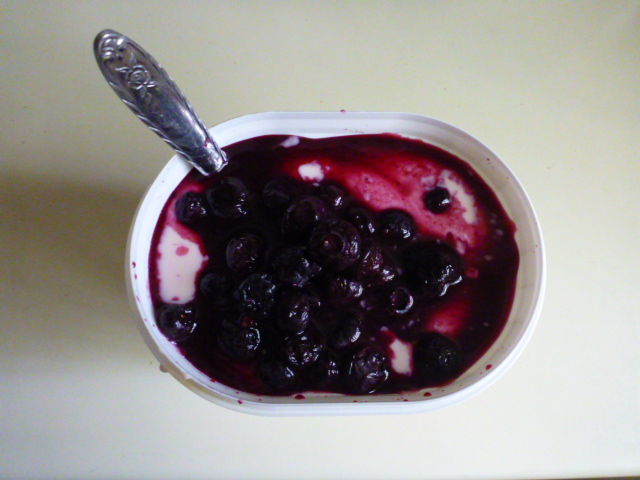
One of the other benefits is that you can add your own extra ingredients. In this case I decided to add some defrosted blueberries to the boysenberry yoghurt.


Mix the berries through and enjoy! Exotic alternatives such as this could also form part of a dessert if desired.


Thursday, August 30, 2012

Coffee Review - Harris Espresso Coffee Beans

Harris Espresso Coffee Beans are described on the packet as "Genuine Italian style coffee. Invitingly aromatic with a deep intense flavour". which is rated as "Strong - 5 beans". The 1kg bag (reviewed) is competitively priced.

Once ground this coffee has an aroma that you just want to luxuriate in. It is rich and dark and compelling with a slight astringency, and makes me think of dark wood panelling and green jungle foliage!

Once brewed In a plunger in this instance) this coffee has a luscious rich 'up-front' flavour which is warm and inviting and a solid aftertaste which lingers on the tongue. It will appeal to aficionados of strong coffee but at the same time has a well-balanced flavour without significant bitterness.

With milk added the dark rich flavour is still there but is rounded out by the texture of the milk. The aftertaste still shines through, as does a hint of a tingle on the tongue.

Coffee Review - Coles Dark Roast Coffee Beans

Coles Dark Roast Coffee Beans come in a 1kg package, which is competitively priced. The beans are 'Fair Trade' and 100% Arabica. The flavour strength is rated as 4, but being someone who appreciates strong coffee, I feel that it probably lies more in the mid-range strength-wise.

The aroma of the freshly ground coffee is smooth and slightly nutty.

On drinking it black (made in a plunger), it has a well-rounded and gentle soul with perhaps a slight hint of fruitiness, and a moderate aftertaste that builds up to a slow crescendo. A tiny tingle on the tongue creeps up on you after a while!

Adding milk seems to enhance the fruitiness and suppress the aftertaste to some extent, leaving a mild and balanced cup of coffee which is bound to please most palates.

Sunday, August 19, 2012

Ave maris stella by Edvard Grieg

It is one of the joys of being on the music repertoire committee for St Francis' Choir that occasionally you are successful in one or more of your suggestions as to music which the Choir should perform. For the current six-month program I have been fortunate in having two suggestions of music by Norwegian composers accepted - "Cry Out and Shout" by Knut Nystedt and Edvard Grieg's glorious gem "Ave maris stella". This letter work has just been performed by the Choir for the first time and received ringing endorsement from both Choir members and members of the congregation.

The tranquil nature of the motet reminded me of the photographs that I had taken of the beautiful lake next to Grieg's home Troldhaugen during a visit to Bergen in June 2004.

After catching a bus to the suburbs of Bergen, it is only a short walk to the Troldhaugen precinct. I remember walking through the front gate and being serenaded by a beautiful young Norwegian girl dressed in a traditional bunad playing a violin (and presumably some of Greig's music). After a short walk down a path in dappled sunlight through a grove of stunningly green birch and beech trees, one first comes to the visitor centre (where the small Troldsalen concert hall is housed) and then it is only a little further to Grieg's house and composer's hut (both overlooking the water) and it is also possible to walk down to the edge of the lake and look up at the tomb which is the final resting place of both Edvard and his wife Nina. I enjoyed sitting in the garden for a time and just looking out over the lake (I seem to recall this may have been interrupted at one point by the predictable Bergen rain!).

It is a beautiful, calm and tranquil place and well worth a visit. Certain areas of the house are open to visitors and you can also look into the composer's hut.

Troldhaugen


The Composer's Hut


Lake Nordås 


The Tomb of Edvard and Nina Grieg

Coffee Review - Hudsons Coffee, Lonsdale Street, Melbourne

Over the past two Sundays I have been able to sample (courtesy of a special promotion) capuccinos made by barista Lynn at Hudsons Coffee in Lonsdale Street, Melbourne.

Both times the coffees have been served nice and hot with a generous amount of froth.

Last week the flavour was soft, mild and well-rounded with a subtle aftertaste. Today the coffee was even better than last time. There was a lovely strong and slightly bitter but smooth flavour and a mild aftertaste, leaving a slight tingle on the tongue. Enjoyable cups of coffee both times!

Hudsons also sell their own coffee beans in a variety of flavours (and a variety of other drinks and some food is available in-store).

www.hudsonscoffee.com.au

In praise of Vistaprint ...

(Updated 09 January 2014 - addendum added.)

www.vistaprint.com.au

I was first introduced to Vistaprint a few years ago by my sister and since then have benefited from their discounted and/or free offers on customised printing, including address labels, business cards, calendars, rubber stamps and fabric/clothing items such as T-shirts.

Their service has always been prompt and the products have received exactly what I have ordered and of good quality. Where these items were gifts they have been appreciatively received. I had a problem with my most recent order at midnight on a Friday night due to being unable to submit a voucher code for a discount, and after I discovered that customer service is normally open until 10pm on weekdays (impressive in itself) I sent an email using the facility provided, which gave a promise to reply within one business day. I was even more impressed when I received an apologetic personalised email on Saturday morning stating that the problem had been resolved and a credit would be provided.

You rarely see such a high standard of customer service and Vistaprint are to be commended for this. I for one will continue to be a loyal customer!

(Vistaprint is represented internationally and also has websites for many other countries.)

As an example, here are pictures of some stickers that I ordered (either free or A$1.49 each!).


Addendum: I did have a problem with one faulty calendar, which was not discovered for some months after delivery. At first Customer Service declined to do anything, citing the period of time that had elapsed, but I wrote back stating that the calendar was still current and citing consumer rights with regard to goods that were not fit for purpose, etc. and then another customer service representative wrote back in a very conciliatory fashion and arranged for the calendar to be replaced free of charge. In the end they were very charming and helpful, which is to their credit, and means that I will remain as a happy customer. However, perhaps the moral of the story is to check everything carefully on delivery so that any issues can be dealt with promptly.

Friday, August 17, 2012

Scandinavian Crime Fiction Book Review - The Black Path by Åsa Larsson

This was another iTunes $4.99 special randomly selected for reading. By the end a feeling had begun to creep over me that much crime fiction is formulaic, and now that I have read a few crime novels it is easier to appreciate why Stieg Larsson's testy and anarchical Lisbeth Salander was a revolutionary "breath of fresh air".

This novel begins in Abisko in the far north of Sweden during winter. A woman's corpse is accidentally discovered covered up in a fishing ark on a frozen lake. She shows signs of having been tortured and is wearing expensive lingerie under her track suit.

Two detectives (a happily married woman with a brood of children and a divorced man who has just lost his beloved cat) are assigned to the case, and they are assisted by Prosecutor Rebecka Martinsson, who is undergoing a tenuous recovery from a nervous breakdown after shooting three men in self-defence.

There are a number of parallels between this work and that of Camilla Läckberg ("The Ice Princess") and Henning Mankell's Wallander series, but the most uncanny similarities lie with "The Ice Princess". Once again we see the seedy underbelly of the Swedish corporate world, with an emotionless oligarch who suffered a deprived and painful childhood. He has a brother-and-sister team as his right-hand persons, and at one stage there is a hint of an incestuous relationship. Kallis Mining is involved in questionable activities in Africa and the quest to cover this up ultimately brings an untimely end to many of the key players. Kallis has a half-sister who is both a seer and a painter (the theme of a key character who is a painter recurs in both "The Ice Princess" and Mankell's works - Wallander's ageing father). She lives with him and his retainers on his large country estate and foresees and prepares for the coming apocalypse.

Martinsson is instrumental in unravelling the threads of the mystery, and in the course of doing this unravels her own feelings for her ex-boss and eventually summons up the courage to act on this.

One murder turns into two once the apparent suicide of a local journalist is investigated, and an elusive contract killer (also linked to Africa) is implicated.

The denouement comes swiftly close to the end of the book. Our two intrepid detectives go to arrest Kallis (who has paid for both 'hits' to be carried out) at the same time that a team of assassins dispatched by the Africans (who have become aware of his shady dealings) arrive at the estate planning to "kill everyone" while Kallis is hosting a dinner party for all his African co-conspirators. They proceed to do this with great efficiency after severing the power (including the gratuitous killing of a small baby) but in a strange twist of fate Kallis' half-sister manages to rescue him and carry him towards the boat landing at the edge of the forest, where (somewhat conveniently) his wife, who has also managed to escape, is abut to make a speedy exit in their boat. The half-sister sinks into the snow and we are led to believe that she bleeds to death (which seems physiologically impossible given the way her wounds are described) and Kallis' wife hauls him into the boat and they speed away into the night. We are given the impression that money will buy him treatment away from prying eyes and a new identity and a new life (their children are safe with their grandparents). Two of the assassins are killed by the detectives and the rest flee.

Martinsson ends up with her boss, the lonely detective hopes to find love with the widow of the murdered journalist (having acquired a new cat in the meanwhile) and Kallis lives to fight another day, which seems profoundly unfair!

I have to admit I have not read many novels in recent years, but it does seem strange to me that the chapters in a number of these crime books are of such irregular (and often extended) lengths, which can make the old maxim of "just one more chapter before I turn the light out" rather challenging!

It is a cleverly-written book and all the threads are woven together in a cohesive way at the end. There are both quirky and believable characterisations, and it was not surprising that the malevolent oligarch turned out to be the person who regarded life as expendable, even that of his closest allies. There was perhaps too much by way of flashbacks to the history behind the murky politics and the ménage à trois, but otherwise a pleasant enough read.

Up, Up and Away - Amber Aviation Academy Flight Simulation Experience

Having had a lifelong interest in matters of aviation and space travel, one of the post-graduate qualifications that I have done as a doctor is in the area of aviation medicine, and although I have never had the funds to 'learn to fly' I did enjoy the experience a few years ago (whilst undertaking the Monash University Australian Certificate of Civil Aviation Medicine in order to become a "Designated Aviation Medical Examiner") of having some time in a Boeing 737 simulator associated with Melbourne Airport.

Recently Amber Aviation Academy has been offering $99 vouchers for a flight simulator experience through a number of outlets, and I thought it would be an ideal opportunity to get a feeling of what is involved in piloting a small aircraft (helpful knowledge from a medical assessment perspective).

Amber are based at Essendon Airport in Melbourne (right near the terminal building) and have a single simulator which offers two options - a Virtual Cessna 172 and a Virtual Piper Seminole Twin Engine. I thought I would try both. Now let it be said that flying these contraptions is not as easy as you might think! Not only do you have to use the rocking steering column to keep the 'plane going up or down at the right angle, but also to turn and/or keep the wings level with the horizon, and when you are on the ground there are foot pedals to turn left or right (not the easiest thing to adapt to when you are used to driving a manual car!). There is also a time lag between performing an adjustment and seeing the response, which can easily lead to over-correction if you think nothing is happening. The Piper required tension on the steering column (like fighting an elastic band) to keep it in the correct position! I also found it challenging sitting so close to the screen as the focal length was too close to feel comfortable, even with reading glasses on.

Do not expect a lesson tailored to your individual learning needs - you will only get standardised scenarios which involve takeoffs and landings and flying around a bit. However, the staff were very polite (if uninclined to casual conversation) and the simulation was run by a qualified flying instructor. I would also not recommend booking for two consecutive hours as I did as the amount of intense concentration was too great and I was pretty washed out at the end and not performing at my best. Bearing in mind these limitations, I would still recommend the experience as a taste of flying - it was fun but there would be a lot of serious effort involved if you wanted to progress from this to becoming a competent pilot.

Siricco Melbourne Relocation Sale - Groovy 60's Suitcase!

For all you lovers of psychedelia, there is now an opportunity to own a very distinctive piece of luggage, which I chanced upon walking past the window of Siricco on the corner of Elizabeth and Lonsdale Streets, Melbourne. Sadly this store (which must have been in the same location for decades) is also relocating for the same reason as the aforementioned Curry Bowl. However, there are a number of other Melbourne outlets: http://www.siricco.com.au/html/s01_home/home.asp

The groovy-looking case is the "Bazaar Retro".


  • ABS material 
  • Polycarbonate coated 
  • 4 rotating wheels 
  • Internal divider 
  • Rubber buffers 
  • Fixed TSA locks

http://www.siricco.com.au/html/s13_shopping/view_product.asp?id=1734&nav_cat_id=16&nav_top_id=shop2 50cm

http://www.siricco.com.au/html/s13_shopping/view_product.asp?id=1735&nav_cat_id=16&nav_top_id=shop2 60cm

http://www.siricco.com.au/html/s13_shopping/view_product.asp?id=1736&nav_cat_id=16&nav_top_id=shop2 70cm

There is a bit of a sale going on in the Elizabeth Street store, so there are bargains to be had, including the 70cm case for only $100! ( Dimensions: 70cm X 42 X 26cm, Weight :4.5kg, RRP:$180, SALE: $120 ).

Monday, July 30, 2012

My Other Blogs ...

Readers of this blog may be interested to know that I have a couple of other blogs which I update from time to time.

1. The Mad Scientist Cooks
This is not the sort of food you would expect to find in a gourmet restaurant, but it is imaginative, wholesome and healthy and easy to prepare using everyday ingredients.
http://themadscientistcooks.blogspot.com/

2. Naked I Came ...
A Journey Through Life In Poetry ...
This is a long-term project to post copies of all the poems I have written since I started writing poetry as a teenager in the early 1970s.
Poems:
Introduction and list of poems:

Feel free to have a look!

Pre-Hospital Medicine Update July 2012

As a member of some Australian Ski Patrol and Search and Rescue Medical Advisory Committees I have been putting together and circulating a Pre-Hospital Medicine Update every few months, containing information on the latest Australian Resuscitation Council Guideline changes as well as quite a few other things. As the contents are quite broad, I thought that it may possibly be of interest to others.

The update itself can be downloaded through the following link:
https://dl.dropbox.com/u/30234302/Pre_Hospital_Med_Update_Jul12.pdf
and the numerous documents referred to in the update are available in a ZIP file that can be downloaded from:
https://dl.dropbox.com/u/30234302/Pre_Hosp_Update_Jul12.zip

Future updates will be posted on this blog from time to time.

Thursday, July 26, 2012

Melbourne Symphony Orchestra 2012 Season - Music of Maurice Ravel

Melbourne Symphony Orchestra 2012 Season
Saturday 21 July 2012 at 8pm
Melbourne Town Hall
(Approximately 2 hours)

Tadaaki Otaka, conductor
Katarina Karneus, mezzo-soprano
Jean-Efflam Bavouzet, piano

Program of music by Maurice Ravel (1875-1937)
Daphnis and Chloe: Suite No.2
Ravel: Sheherazade
Interval
Piano Concerto in G
Bolero

This was a rare opportunity to hear four of Ravel's works on the same program, occasioned by the MSO's special offer (advertised in "The Age" newspaper) of "Three Concerts for A$99, an offer too good to pass up.


Our seats were in the second-back row of the balcony, which had a clear view of the stage. It appeared that the concert was all but sold-out, as there was only a handful of vacant seats. Free programs were once again available.


The first piece, Daphnis and Chloe: Suite No.2 had an unmistakeable French impressionist feel about it. Not having read the program at this point, the opening section reminded me a lot of gently lapping waves and Debussy's La Mer. It continued on in a similar vein for a while, at times sounding more pastoral or alternately very much like a broad sweeping film score in the Casablanca genre - you could almost see a touching scene between Humphrey Bogart and Ingrid Bergman! Towards the end of the piece the music became much more agitated, sounding like a storm that had blown in, and finished in this mode. Otaka is a very elegant conductor to watch, and he managed to bring out the best in terms of the well-crafted musicianship of the orchestra.

Swedish mezzo-soprano Katarina Karneus acquitted herself well with the three songs of Sheherazade. She was a resplendent figure in stage in a cardinal red gown, but perhaps the choice of a halter-neck and a clinched waist with jewelled buckle was not the most suitable for her body-type. For most of the performance the orchestra provided an appropriate level of accompaniment but at times she was a little "drowned out". This was a charming and pleasant piece which well showcases the skills of the soloist.


The highlight of the program was probably the Piano Concerto in G, with soloist Jean-Efflam Bavouzet, who played with extraordinary energy and panache. There are obvious jazz and blues elements included in the score, including the influence of Gershwin's Rhapsody in Blue. This is an exciting piece which was executed well by both orchestra and soloist, and was very enthusiastically applauded by the audience. As an interesting aside, Bavouzet also has a Scandinavian link - he is the Artistic Director of the Lofoten Piano Festival in Norway. This simply fabulous group of islands is well worth a visit!

During the break between the two final pieces I ran foul of an usher whilst attempting to take one final non-flash photograph for this blog posting. I was told that there was no photography allowed during the performance, and when I countered that I was not taking photos during the performance, I was told that the break was also part of the performance! There is no signage in the Town Hall pointing this out to patrons nor any mention of it in the program or on the web site. I was upset by this, as I only wanted the photo to help promote the orchestra, and there is no way that a non-flash photo in the second-back row of the auditorium respectfully taken during the break would have been capable of distracting anyone. So, I put my camera away 'sans photo' but to make matters worse the usher sat right behind me breathing down my neck for the Bolero to make sure that I did not transgress. As a result, I was the one who was distracted and was no longer "in the zone" and able to enjoy the music to the same extent. It is one of those curiously unsettling human 'sixth senses' when you know someone is staring at you from behind. As a result, I dared not move a muscle lest it was misconstrued as a movement towards my bag and the offending camera.

The audience loved the performance, and Robert Clarke on the snare drum, appropriately placed centre stage, capably and consistently provided the rhythmic drive for the piece. I don't think that I ever saw the movie "10" with Bo Derek that made the Bolero somewhat infamous, and it is probably a good thing that it is now so long ago that many people would not be aware of this association. It was good to see the piece played as it was intended by a high-calibre ensemble, and to to hear the way that the theme colourfully swirls around the orchestra, all the time grounded by the incessant beat of the drum. It is a very clever piece whilst being quite primal at the same time, and it is not hard to understand its popularity.

Oodles of Flavour - Noodle Hut, Fairfield

Noodle Hut
136 Station Street
Fairfield Vic 3078
Tel: (03) 9481 2443
Hours: M-Th, Sat 11.30-21.30
Fri 11.30-22.00
Sun 17.00-21.30
CASH ONLY

This is a local eatery right next door to the Great Bite Fish and Chips (previously reviewed favourably!). There are other outlets of the same franchise aeound Melbourne.

They have a reasonable variety of Wok Tossed Noodles, Soups. Rice Dishes and Side Dishes (incuding vegetarian) and offer a fast and efficient service.

Our group tried out three dishes on this occasion: 


* Noodle Hut "Inferno" - thin egg noodles cooked with a combination of chicken, beef, roast pork and vegetables in a special chilli sauce ($10.80);

* Singapore Fried Noodle - stir fried thin rice noodles with light curry, shrimp, roast pork, bean shoots, onion, capsicum, carrots, egg and shallots ($10.80); and

* Fried Kwai Teow - stir fried thick rice nnodles with roast pork, shrimp, bean shooots, onion, capsicum, carrots, egg and shallots in a dark soy and chilli sauce ($10.80).

These were all very nice, with clearly fresh ingredients, and moreish i.e. it was difficult to stop eating them! The flavourings were quite mild and nothing to be fearful of. There was a good balance of noodles, meat and veggies, but it was a bit disappointing that most of the sauce was concentrated down the bottom of the pack, so I would recommend perhaps transferring the noodles into a bowl and mixing through prior to service. I particularly liked the Kwai Teow - the noodles were "melt in your mouth".

If you are after reasonably price, quick and relatively healthy food it is difficult to go past food like this. It is unpretentious and you know what you are getting, but without the risks of street food. Recommended!


Thursday, July 19, 2012

Polar Dreams – Antarctica and the Arctic

On 18th July I attended a World Expeditions Adventure Presentation on voyages to the Arctic and Antarctica presented by Greg Mortimer.

From their blurb:
“Greg Mortimer is a pioneer in Polar tourism. Antarctica and the high Arctic have dominated his life for the past three decades. Greg has worked as a geologist in Antarctica, was one of the first Australian’s to climb Minto, the continents highest peak, and has personally led over 80 voyages to the region since 1992. No other Australian has more passion, or knows more about the Polar Regions, than Greg.

Join Greg as he outlines the numerous opportunities available to you to experience the wild untamed magnificence of Antarctica and the high Arctic. Discover what you could be doing in some of the world’s most precious and extreme wilderness landscapes, from South Georgia to the South Shetland Islands, the Antarctic Peninsula to the remote Ross Sea and as far north to Spitsbergen, Greenland & Iceland.

Greg’s visual voyage will provide you with a deep insight into the wildlife, history, majestic icescapes and of course what it’s like on board our ships and what gear you’ll need to take.”

Greg is a very humble person despite his many and varied achievements and it was a very enjoyable evening as he shared his personal account of what it is like to visit the polar regions.

Having lived and travelled extensively in Norway, including an Expedition Medicine course near Alta in the Norwegian Arctic, and visited Iceland (promptly falling in love with the remarkable landscapes), visiting places like Greenland and Svalbard and seeing polar bears (my favourite animal) up close and personal (but not too close!) is on my “bucket list” and readers of this blog will know that I have long had a hankering to visit and/or work in Antarctica. For a couple of years I have been trying to ‘get a gig’ as a ship’s doctor with one tour company, but no luck so far (keenly competitive as you might imagine – no pay but you get the trip for free!).

Greg shared his stories, personal impressions and some stunning photographs of Svalbard and Spitzbergen, Iceland, Greenland and Franz Josef Land (not a place many of us had heard of before) and some close encounters with polar bears. He also talked about the amazing bird life.

Moving to the other end of the world, he talked about Ushuaia, the setting off point in Argentina, the voyage to the Antarctic Peninsula, South Georgia, the main Antarctic continent and Macquarie Island and the varied climates, terrains and animal life in these different areas. There was one fun photo of ‘camping out’ in Antarctica under the midnight sun!

Greg told us that he had been to Antarctica 100 times, and holds a wealth of knowledge about the polar regions and its history. He will be leading some of the trips during the 2012-13 season, including a new “Ross Sea Explorer” trip travelling from New Zealand to Antarctica.

Based on what I saw during the presentation, World Expeditions appears to be a reputable, professional and responsible company and would be well worth considering if you are thinking about a trip to the polar regions. As for me, I would still love to go so will have to continue working on trying to find that ‘lucky break’!

For further information see:
www.worldexpeditions.com
info@worldexpeditions.com.au

Tuesday, July 17, 2012

Movie Review - Prometheus


This is Ridley Scott's 'prequel' to the "Alien" series. The title of the film is in itself a clever literary allusion as the film is both about the creation of humankind, the quest for scientific knowledge and unintended consequences – “fools rush in where angels fear to tread”!

(From Wikipedia) “Prometheus is a Titan, culture hero, and trickster figure who in Greek mythology is credited with the creation of man from clay and the theft of fire for human use, an act that enabled progress and civilization. He is known for his intelligence, and as a champion of mankind. The punishment of Prometheus as a consequence of the theft is a major theme of his mythology. Zeus, king of the Olympian gods, sentenced the Titan to eternal torment for his transgression. The immortal Prometheus was bound to a rock, where each day an eagle, the emblem of Zeus, was sent to feed on his liver, only to have it grow back to be eaten again the next day. In the Western classical tradition, Prometheus became a figure who represented human striving, particularly the quest for scientific knowledge, and the risk of overreaching or unintended consequences.”

The opening cinematography is absolutely stunning and would be worthy of any quality nature documentary. I had a hunch that it was my beloved Iceland (and the closing credits proved me correct), and we were treated to a spectacular vista of glaciers, glacial rivers, craggy mountain peaks, valleys, lakes and waterfalls. Visiting Iceland was one of the highlights of my life and I would certainly recommend having it on your "bucket list"!

(Note: Wikipedia is acknowledged as the source of some of the plot description.)

The introductory sequence itself is rather puzzling. A solitary hooded and robed figure strides to the edge of a waterfall, and reveals himself to be a powerfully muscled albino. A spacecraft hovers overhead and he opens a small container which is filled with a seething dark liquid. He consumes it, starts to convulse, his appearance changes and he literally starts to fall apart and topples into the waterfall just as a hovering spacecraft leaves. In the water his body appears to dissolve and his DNA rearrange itself and spontaneously develop into a new life form, the cells of which divide and multiply.

In the next scene we are introduced to two of the main protagonists - Drs Elizabeth Shaw (played by the luminous Noomi Rapace of "The Girl with the Dragon Tattoo" fame) and Charlie Holloway (Logan Marshall-Green), who are on an archeological dig on the Isle of Skye in 2089. They discover a wall painting that features a particular constellation that has independently been found depicted in a number of other locations around the world. They conclude that it is a guide map left behind by travellers (“the Engineers”) who want humanity to find them, the creators.

A deep space mission by the scientific vessel Prometheus to the distant moon LV-223 is funded by the Weyland Corporation. The human crew travels in stasis whilst the ship’s caretaker is an android named David (Michael Fassbender), who rather fancies himself as ‘Lawrence of Arabia’, adopting Peter O’Toole’s hairstyle and accent. Since the nearest star, Proxima Centauri, is 4.22 light years away, it is not clear how the Prometheus manages to reach its mission objective in a mere four years. Upon arrival the motley crew (in common with all “Alien” movies some people are there “just for the money”) wakes up and the full details of the mission are revealed by a hologram of an ageing Peter Weyland. Mission director Meredith Vickers (Charlize Theron) tells the scientists that she is boss. Conveniently they find a series of built structures on the surface of the moon and land the ship and go to investigate.

Inside the first of the structures, they find numerous stone cylinders, a monolithic statue of a humanoid head, and the decapitated corpse of a large alien, thought to be an Engineer. They find other bodies and presume that “no-one is home” alive. At this point I became a little agitated, as their biohazard precautions were less than ideal and I would not want these people keeping me safe from alien contagion. David secretly takes a cylinder, while the remaining cylinders begin leaking dark liquid. This liquid looks and behaves in a similar way to the infamous black oil in the “X-Files”.

A rapidly approaching storm forces the crew’s hurried return to Prometheus with the decapitated head, leaving lost crew members Millburn (Rafe Spall) and Fifield (Sean Harris) stranded in the structure overnight at the same time there is a “bogey” detected moving around inside.

Back on board Prometheus, in a cunning piece of wizardry that contains a direct reference to the original ”Alien” movie, it turns out that the alien head is wearing a helmet, which when removed reveals a very life-like humanoid head almost identical to the alien in the opening segment. DNA is extracted and found to match that of humans, and when residual electrical activity is detected in the head it is “brought back to life” with interesting consequences. Meanwhile the malevolent David, who has clearly never heard of Asimov’s Laws of Robotics forbidding harm to humans (not to harm or by omission of action, allow to be harmed, a human being), investigates the cylinder and discovers a dark liquid. He then taints a drink with the substance and gives it to Holloway. Shortly after, Shaw and Holloway have sex. At this point, things are a bit confused. There is clearly a hidden agenda, but what is it and who are the bad guys? David is one of them, and he seems to be collaborating with Vickers and another unseen person.

Bad things happen to the two men trapped inside the structure. A snake-like creature kills Millburn, and sprays a corrosive fluid that melts Fifield's helmet, exposing him to the leaking dark liquid. In echoes of “Alien”, we once again see humans being unpleasantly intubated by alien life-forms, and have the sense that this is somehow linked to that storyline. The crew later returns to the structure and finds Millburn's corpse. David goes off on a frolic of his own, even severing the video transmission to Vickers, and separately discovers a control room containing a surviving Engineer in stasis, and a virtual star map highlighting Earth (the special effects are absolutely stunning in this segment, including a 3D hologram of the Earth which wistfully fades away when the projection abruptly shuts down). At this point we are really wondering about David’s hidden agenda and recalling the folly of corporation hacks who thought that they could subdue an Alien and bring it back to Earth.

Holloway's ingestion of the dark liquid leads to an infection that rapidly ravages his body. He is rushed back to Prometheus, but Vickers refuses to let him aboard, and at his urging, burns him to death with a flamethrower. Later, a medical scan reveals that Shaw, despite having earlier revealed that she is unable to have children, is pregnant with an alien offspring. Shaw manages to escape from David and the fellow crew members that want to put her back into stasis (to ensure that the alien embryo is transported back to Earth – echoes of the “Alien” franchise again) and is just desperate to rid herself of the creature. There is an automated surgery table on the ship and she optimistically asks for a caesarean but it replies that it is only programmed for male anatomy and cannot comply. Whoever heard of such craziness – sending a robotic surgeon into deep space just to operate on males – I don’t think so! Thinking laterally, she orders it to perform the removal of a foreign body from her abdomen and has to undertake some pretty gutsy self-anaesthesia. Conveniently the machine has what looks exactly like a pair of birthing forceps to extract and subdue the squid-like creature. Shaw escapes and stumbles around for much of the rest of the movie clutching her stapled abdomen and in great pain. I have seen some women happily walking around the day after a caesarean but Shaw is really forced to ‘push to the max’ physically in order to survive.

Weyland (Guy Pearce) is revealed to have been in stasis aboard Prometheus pulling the strings, and explains to Shaw he wants to ask the Engineers to prevent his death from old age. As Weyland prepares to leave for the structure, Vickers calls him "Father". Before the party can leave, a mutated Fifield attacks the hangar bay and kills several crew members before being killed himself.

The Prometheus's captain, Janek (Idris Elba), speculates that the structure was part of an Engineer military base that lost control of a virulent biological weapon, the dark liquid. Janek also determines that the underground structure is in fact a spacecraft. The shape of the spacecraft is eerily similar to the one seen crashed in the opening scenes of the “Alien” movie, so various strands of the backstory have been woven together by this point.

Weyland and a team return to the structure and are foolhardy enough to awaken the sleeping Engineer. David, who has been studying Earth’s ancient languages during the long trip, speaks to the Engineer, who responds by decapitating him and killing Weyland and his team. Shaw just escapes the spacecraft as the Engineer prepares to fly away. Shaw warns Janek that the Engineer is planning to release the liquid on Earth and convinces him to stop the spacecraft via a suicide mission. Vickers and her lifeboat are ejected before Janek bravely collides the Prometheus with the Engineer's spacecraft. The Engineer's disabled spacecraft crashes onto the planet and rolls across the landscape, killing Vickers and finally dispelling that nagging doubt that Vickers was also an android.

Shaw goes to the lifeboat and finds her alien offspring, which is still alive and has grown to gigantic size. David's still-active head warns Shaw via radio that the Engineer survived the crash and is coming after her. The Engineer forces open the lifeboat's airlock and attacks Shaw. She releases her alien offspring onto the Engineer; it thrusts a tentacle down the Engineer's throat, subduing him.

Shaw feels that she needs to know why the Engineers would want to destroy the human race, which they had created. As there are more buried alien spacecraft which David believes that he can fly, she enters into a pact with him and recovers his head and body. In the dying moments of the film they launch another Engineer spacecraft as Shaw intends to reach the Engineers' homeworld in an attempt to understand why they wanted to destroy humanity. In the lifeboat, a large alien creature bursts out of the Engineer's chest. Guess what? It’s the same lifeform as in “Alien” except with pink gums and a very human looking set of choppers (teeth) rather than the metallic variety that we became so used to.

It is a good ensemble cast, with stand-out performances from Rapace, Fassbender and Theron. At times it is difficult to work out whether Shaw has an English or a Continental accent, and she has a tendency to mumble, detracting from the import of what she is saying. Fassbender is absolutely chilling as the soul-less and mercenary David, and Theron again impressively reprises the role of an ice-queen.

Although the plot does contain several predictable elements from the “Alien” franchise, it hangs together reasonably well and continues to surprise. Like Ripley and her android Bishop, Shaw and David are the sole survivors, leaving scope for a sequel if they do in fact make it to the Engineers’ homeworld.

The aforementioned scenery is stunning, as are the special effects. However, the underlying premise of the plot, that the Engineers would want to destroy humanity (a relatively primitive race) after having gone to all the trouble of creating them, remains perplexing. A friend of mine has it all worked out. He thinks it is all to do with intergalactic trade and there is a missing link with the “Alien vs Predator” franchise, in which the Aliens were bred for the Predators to hunt. Imagine the profits if you infect a whole planet and create a bottomless supply of Aliens! The whole deal may well have been brokered by the Ferengi, who are not unfamiliar with the Rules of Acquisition!

While it is not viscerally challenging in the same way as the raw horror of the original “Alien” movie or the sequel “Aliens”, there is sufficient unpredictability and murkiness of purpose to keep you guessing and at times on the edge of your seat. There is certainly a sense of the ‘puniness’ of humans in the overall scheme of things and it is in many respects a cautionary tale not “to mess with things you do not understand”. Both the humans and the imperturbable David (even when decapitated) are ill-prepared for what they actually encounter, and make the fatal mistake of assuming beneficence on the part of the creator Engineers. We see the whole craziness of what makes up human nature – love, folly, bravery, risk-taking, the quest for exploration and finding answers, betrayal, sacrifice and the will to survive.

Is it groundbreaking in the same way as “Alien”? No. Is it clever, complex and interesting? Yes. Does it raise more questions than it answers? Yes. Did I enjoy it anyway? Yes.

Sometimes watching a movie like this with some fairly significant unexplained portions of the plot is a bit like being a scientist in real life – we want to know all the answers but sometimes we just have to admit that nobody knows at the moment! The difference with a movie I suppose is whether it is a convincing enough package to engender a “willing suspension of disbelief”. This is one where you will have to decide for yourself!

CPD for Doctors (and Medical Students) - A Never Ending Story!

The Royal Victorian Eye and Ear Hospital (in conjunction with General Practice Victoria) presents some excellent clinical update seminars primarily aimed at GPs several times each year: http://www.eyeandear.org.au/page/Health_Professionals/Referring_to_the_Eye_and_Ear/Education_and_training/

These are always of a high standard and presented by experts in the relevant areas.

There is also a series of Saturday morning lectures in Otolaryngology and Dermatology suitable for medical students in their clinical years:
http://www.eyeandear.org.au/page/Health_Professionals/Education_and_Training/
http://www.eyeandear.org.au/content/Document/Training%20and%20Education/Saturday%20morning%20lecture%20series.doc

Between June and September of each year a Short Course in Perioperative Medicine is conducted by Monash University in conjunction with the Alfred Hospital Department of Anaesthesia and Perioperative Medicine. See: http://www.periopmedicine.org.au

This is primarily an online course with reading materials and a video lecture for each of the twelve weeks of the course (with multiple choice questions to complete for each unit), and an intensive face-to-face weekend at the Alfred at the conclusion of the course. 

Many aspects of perioperative management are covered and some of the topics included in the twelve units of the course are:
* Coronary artery disease and hypertension
* The Cardiac patient for noncardiac surgery
* Perioperative cardiac risk assessment and testing
* Heart failure
* Arrhythmias, pacemakers and AICDs
* Anticoagulants, antiplatelets and thromboprophylaxis
* Blood Transfusion Medicine
* Airway management
* Sleep apnoea
* Pulmonary disease
* Endocrine disorders
* Obesity
* Allergies and anaphylaxis

It has been an enjoyable (and very comprehensive) course so far but requires a fair degree of commitment as to date it has taken around a day to complete the materials for each unit.

A Diploma and a Masters in Perioperative Medicine are also available.

The second Melbourne Medical School annual MD Student Conference was held at the Melbourne Cricket Ground from 2-5 July 2012. This is a compulsory course component for MD students (the new graduate MD program is now in its second year) and covered a variety of areas including Clinical Research and Indigenous Health, Medicine & the Law and Healthcare Systems, Dealing with Death and Adaptation to Change, Mental Health & Well-being for Medical Students and Social Determinants of Health and Career Development.

Victorian Remote Area Nurse Update Program 2012 and Alpine Medicine Presentations

In July last year I attended the 2011 Emergency Management Conference in Melbourne and struck up a conversation with the Ambulance Victoria representative who was responsible for educational updates for the Victorian Remote Area Nurses, a group of remarkable (mostly) women who work in small bush hospitals and remote towns and are the medical first responders for their community. It seemed that there were some commonalities between the work that RANs do and the work that ski patrollers do as first responders in remote locations, and I offered (by way of networking) to assist with the annual update program for the RANs.

This is run annually as a two day program in both May and June, and the RANs are given a number of update lectures as well as rotating their way through a series of practical competencies designed to refresh their skills and assess their competency to practise these skills in a diverse range of areas. RANs must successfully complete some workbook materials prior to attending the Update. The workstations are manned by a very dedicated, knowledgeable and experienced group of (mainly) rural ambulance officers and midwives, and all materials are based on an extensive Learning Support and Resource Material package and the splendidly comprehensive Remote Area Nurses Emergency Guidelines (available from http://www.ambulance.vic.gov.au/Media/docs/RAN%20Guidelines-81ae0568-940d-404d-acd9-aae84eeeea0c-2.PDF). These are a great resource, and I have used them myself for training purposes.

The workstations cover:
1. Obstetric Emergencies
2. Respiratory Emergencies and Airway Management (Adult)
3. Altered Conscious States and Medical Emergencies (Adult)
4. Trauma (Adult)
5. Cardiac Emergencies (Adult) including CPR and DCCS (AED)
6. Paediatric Emergencies (Trauma/Cardiac) including CPR and DCCS (AED)
7. Paediatric Medical Emergencies (including Respiratory)
8. Splinting and Environmental Emergencies.

I was honoured to be invited to give a lecture to the RANs at each of the updates and to attend one of workstation sessions as an observer.

After discussions with the coordinator, the lecture I gave at the first update program covered Ski Patrol First Aid training and medications, ski resort demographics and injury profile, polar medicine training in Norway, hypothermia and local cold injuries and altitude illness. This involved a large amount of preparation, but skimming through the first sections and concentrating on the cold injuries and altitude illness I was able to fit it into the 45 minute allocation.

Shortly before the second session I received the feedback that the RANs found the presentation interesting but would have liked more material on hypothermia. I had presented all the existing material on hypothermia and local cold injuries in full so the only way to achieve this was to add extra material at the cost of the other areas in the presentation. The revamped presentation dealt only with these issues, which was a pity from my perspective, as a lot of work went into the other material, but I guess there is always hope that one will be able to use it on another occasion.

I have made the three versions available from Dropbox as a resource (but if any of this material is used due acknowledgment should be given to the sources as I have done at the end of the presentation):

Version 1 (original version covering all topics [129 slides]):
https://dl.dropbox.com/u/30234302/RAN_Alpine_Med_RC_2012.pdf

Version 2: (expanded version covering all topics [174 slides])
https://dl.dropbox.com/u/30234302/RAN_Alpine_Med_RC_2012_v2.pdf

Version 3: (abridged version covering only hypothermia and local cold injuries [90 slides]): https://dl.dropbox.com/u/30234302/RAN_Cold_Injuries_RC_2012.pdf

Monday, July 16, 2012

Some like it hot - Curry Bowl, Melbourne CBD

Lovers of curry will be saddened to hear that the Curry Bowl diner on Elizabeth Street has closed today (Sunday 15 July 2012) after thirty years in the same spot (due to redevelopment of the building). Their home-made Sri Lankan curry came in two forms - individual servings of curry treats such as samosas and potato balls, and generous platings of curries with rice (Regular, Biryani or Vegetarian Combos in small and regular serves for under $10).

There was normally a choice between plain and Biryani rice (with cashews), several vegetarian curries (today lentils, eggplant and a mixed vegetable curry) and chicken, beef or lamb curries. With the larger serving you could get samples of two vegetarian and two meat curries together with the rice. By way of tasty accompaniments yoghurt, pickle and chillies were available, together with two small pappadams for each person.

The curries were all nicely seasoned, and although the chicken was on the bone it was tender and came away easily. The meat was cubed and neither too dry nor too tough, with tasty sauces. The small strips of fried and curried eggplant were outstanding. The lentils were a nice golden colour and mildly spiced. Even the smaller serve was generous, and it was a very enjoyable meal, which more than compensated for the 'no frills' surroundings. The staff were always very friendly and genuine, and came across as taking pride in their food and the enjoyment that people gained from it.

There is another Curry Bowl in the city near the corner of Lonsdale and Exhibition Streets. Apparently the ownership is different, but the menu is similar, so one can only hope that the tasty food and admirable ethos will live on in the surviving location.

Curry Bowl on Urbanspoon

Review - "Moonshadow" the Musical

Currently playing at the Princess Theatre, Melbourne
http://www.moonshadowthemusical.com.au/

When I was a teenager I enjoyed the music of Cat Stevens, and was somewhat dismayed when he became Yusuf Islam and left his musical career behind. In recent years he has become just "Yusuf" and resumed his life as a performer in various ways. I was somewhat sceptical when, together with his co-writers he developed the musical "Moonshadow" as a 'feel-good' story showcasing the music of Cat Stevens. I had originally decided not to attend, but was offered a ticket as a birthday present. In the end I felt badly disappointed and wished that I had not accepted this kind offer.

I must preface this review by stating 'up front' that I am not a big fan of musicals, so they have to be truly exceptional for me to enjoy them. As someone who is a choral performer, I generally get a lot more pleasure from performing than sitting still and listening.

"Moonshadow" is decribed as "a life-long dream of its producer, Cat Stevens" which weaves forty of his songs (old and new) in some way into the production. It is a "magical story with themes that are both powerful and universal. It is about hopes and dreams, greed and power, right and wrong, but most importantly Moonshadow is about finding happiness and love".

The young performers playing the key roles of Lisa, Stormy and Patrick did an excellent job. For me Patrick was the stand-out performer, with a great voice and charisma and stand-out moves. He doesn't get the girl in the end but I felt that he deserved to!

The parents of Lisa and Stormy were also sensitively portrayed by older performers and were quite believable.

The sets, costuming and stage management were well done. It is interesting with the costuming that there are women and men with both covered and uncovered heads, and I wonder if this was a cultural tribute. There was a live band in the orchestra pit, but I felt a lot of the time the bass aspect predominated. The whole show started with a very strange synthesiser introduction. One thing that really 'bugs me' is that so many Australian performers insist on singing with an American accent rather than a more neutral accent. It grates, like fingers on a blackboard (a concept which is perhaps unfamiliar to a whole generation!).

Off-stage at various times we see the black and white "good shadows" (one of whom has a long white beard, looking not unlike Yusuf himself), and Moonshadow is sent as their emissary to Stormy, 'the chosen one', to assist him on his journey to rid the world of darkness. Moonshadow was perhaps the greatest disappointment. In short, despite being on stilts and towering over everyone else, he was a 'wimp', with insufficient persuasive powers over Stormy, who for most of the production is a "boy behaving badly".

In terms of the synopsis, parts of which are surely an allegory for Yusuf's own journey through life, we are introduced to a world where darkness is the norm and daylight is just a memory (not unlike the Norse 'Age of Ragnarok' where the wolf has swallowed the sun). Lisa and Stormy (who bears an uncanny resemblance to Julian Assange with a shock of white hair) were childhood sweethearts, and Stormy has a dream of finding the light and bringing it back to the world. He gives a picture of a tree bathed in golden light to Lisa, and she gives him a pendant worn by her late mother. They both promise to stay true to the dream. While Stormy remains in town, Lisa is sent away by her father to live with her aunt. She only returns after her aunt's death, and Stormy is reminded of his feelings for her, but Lisa's father has plans for her to marry Patrick, the son of Mr Matthew ("Matthew and Son").

For some unknown reason, although they live across the street from each other, Lisa's father and Stormy's father have developed a dislike for each other (although the two mothers were secretly friends). Mr Matthew seems to be the only one in town with any money, and Stormy's father derives their living by selling coffee and coffee beans. This is one of the humourous aspects of the production.

After Moonshadow appears to Stormy and informs him of his destiny as 'the chosen one', Stormy decides that "I know I have to go" and sets off on a journey of redemption to try to find the light. We are given the impression that this is a quest with a higher purpose, not unlike the search for the Holy Grail. However, Stormy is no Frodo, and things go downhill from here. The production wanders aimlessly over the next few scenes. Stormy finds a market in the country, ends up playing the guitar to an enthusiastic audience but shortly after Moonshadow essentially says "quit while you are ahead", someone gets robbed, the crowd blames Stormy, he gets beaten up and gets taken to the "House of the Half-Dead". With Moonshadow's help (after a quick prayer, perhaps another personal inclusion for Yusuf) he escapes, and then wanders off into a forest, where he encounters the evil Princess Zeena, who promises him what he has always been dreaming of.

At this point he conveniently forgets about those he has left behind - his parents and the love of his life, Lisa. A troupe of hippies wander along, and they seem to be on a bit of a 'trip', another clever allusion to the "sex, drugs and rock'n'roll" lifestyle of the 1970s. Stormy gets a new cloak, a new electric guitar and a lot of attention from the girls. Princess Zeena takes him to her home in the clouds, laughing all the way (and it is pretty clear that she has some barely-disguised evil intent). Interval arrives, and I am bored. I cannot see the point of the drawn-out previous few scenes, and feel disappointed that Stormy has been so quick to forget his mission and those that he loves.

After interval, the story is wrapped up with breath-taking speed. Moonshadow 'breaks the rules' and touches a mirror to try to help Stormy to "see himself". As a result, he begins to be visible to people other than just Stormy, incuding Zena. Before long, we see Stormy trapped in a cage, Zeena managing a factory that looks a lot like what we would expect Hell to be, and Moonshadow about to be extinguished by Zeena, who laughs maniacally, looking forward to stealing the last bit of light from the world. Mr Matthew also seems to be a collaborator.

Suddenly Stormy is free, running along a bridge with flames on either side. It was pretty unclear how this has happened, along with Moonshadow's reappearance. Stormy sees a vision of his future son, and somehow his reaction to this leads to the light being restored to the world. Then Stormy as 'the prodigal son' rides back into town, just as Lisa is about to be married to Patrick. In Stormy's absence Lisa's father and his father have resolved their differences.

The second-half of the plot seemed quite unsatisfactory, and was concluded with indecent haste. In the all-singing and dancing conclusion, Lisa and Stormy are reunited, light is returned to the world, and it seems that there is hope for the future for everyone. Even the jilted Patrick does not seem too unhappy. There is a touching cameo by the young Lisa and Stormy, singing "Morning has broken".

This is a production that promises so much but delivers so little. Although the music is timeless, the treatment of it was often not ideal and detracted from the enjoyment of familiar tunes. However, the greatest barrier to enjoyment is the gaping holes in the plot and to my mind Stormy did not do enough to redeem himself and at no point asks for forgiveness from those he betrayed. Patrick had worked hard to win Lisa's love, and obviously genuinely cares about her, but is instantly cast aside when Stormy returns. I felt empty at the end. It would have been much more meaningful (and genuine) to see Yusuf himself in concert.

I can't recommend it, but perhaps it would appeal to less-discerning young audiences or family groups. The musical was given its world premiere in Melbourne, so it will be interesting to see where it goes next.

A variety of souvenirs are available and are reasonably priced.

Friday, July 6, 2012

Medical Book Reviews: Jayasinghe ECG Workbook and Robbins Basic Pathology 9th Edition


Elsevier Australia has kindly provided me with inspection copies of the following medical books.

1. ECG Workbook. (Professor) Rohan Jayasinghe.

Churchill Livingstone/Elsevier Australia, 2012. Paperback, 224 pages. RRP $59.95.

For many people ECGs are a bit like "Who's afraid of the big bad wolf”? In reality this includes quite a few of us. In medical school there are people who "just seem to get it" while others continue to struggle, and still "have their L-Plates on" after many years of medical experience.

This refreshing book is aimed at the clinical interpretation of ECGs. It is worthwhile to quote from the Preface written by the author:
“ECG Workbook provides an easy but systematic algorithm to follow when attempting to read an ECG. The exercises are aimed at training the reader to practise this algorithm repeatedly with different ECGs. The real-life clinical synopsis essentially links the ECG findings to the patient’s clinical context. This information guides the reader to make a clinical diagnosis with the help of the ECG findings, and then to decide on the optimal treatment or management plan. … It is hoped that by completing this workbook the reader will gain the required mastery to use ECG as a clinical diagnostic tool effectively and to make suitable management decisions with confidence.”

It is divided into three sections: 1. Basics of the ECG; 2. ECG-based diagnosis: pathology by ECG; and 3. ECGs and pathologies. There is also an Appendix listing the NYHA functional classes, and a detailed Index.

Beginning with Section 1, the pages are cleanly set out, with ample use of coloured headings, colour-shaded boxes for important points and plentiful use of explanatory diagrams. This chapter of 19 pages does indeed cover the basics in a very understandable fashion. It includes the cardiac cycle, the cardiac conduction system, ECG rate, scale and calibration, leads and direction of current travel, determining the cardiac axis and the causes of axis deviation, placement of electrodes and the difference between electrodes and leads, correlation of the leads to the region of the heart, and finally, reading the ECG. This includes a system for doing this together with the parameters of the normal ECG. To compliment rather than insult the author, for those craving a "Dummies' guide to the ECG", this is exactly the sort of thing you are looking for. The chapter is pitched at a good level and easy to follow, and puts the reader in a good position to approach the chapters on pathology that follow.

Section 2 is a chapter of 27 pages. It is set out in the same clean and comprehensive fashion as Section 1. An introduction on reading rate and abnormalities on an ECG is followed by a discussion of various pathologies, starting with different types of tachycardia and their management. Also discussed are bradyarrhythmias and bradycardia, heart block, abnormalities of the cardiac rhythm, normal and abnormal segments of the ECG, ventricular hypertrophy, myocardial infarction and ischaemia, other pathologies with mixed ECG changes, and finally pacemakers. All the common pathologies are discussed as well as some more obscure ones. Section 2 sets up the background for Section 3, which contains the ECG worksheets. After a brief introduction, 45 case studies follow.

The case studies are beautifully set out in two sections each. The first section contains an ECG on the left-hand page and a template for systematic interpretation on the right-hand page, including the various aspects of the ECG, further investigations and management. Before you start to feel that familiar rising sense of panic regarding "but what is the answer?", relax! The second section of each case study includes all the answers, and helps to drill the reader in the recommended approach to systematic interpretation, and helps to build confidence, as your answers can be directly compared to the recommended ones.

Being a paperback of around 250 pages, this book is very portable, and as well as being a workbook is also a handy reference, both in terms of Sections 1 and 2, but also the wide variety of ECGs included in Section 3. It is well-written, accessible and user-friendly. I would certainly recommend it, especially for those who feel a need to improve their ECG skills in a systematic fashion.


2. Robbins Basic Pathology. 9th Edition. Editors: Kumar, Abbas and Aster.

Elsevier Saunders, 2012. Hardback, 928 pages. RRP $103.99

Owners of the book can register it at studentconsult.com, which provides the facility to access the full text online, download images, add notes and bookmarks and to search across all individually owned Student Consult resources online. The online version of the book contains a special additional feature, "Targeted Therapy" boxes (stemming from an understanding of the molecular basis of disease), intended to provide examples of "bench-to-bedside" medicine.

When I was a medical student, our pathology 'Bible' was Robbins Pathologic Basis of Disease by Cotran, Kumar and Collins. I am the proud owner of the sixth edition and its little pocket handbook. This new book is the latest in a trusted and proud lineage. Many of the earlier products are also available via the Elsevier website. Back in those days material available on CD-Rom was considered pretty special and computer-based learning was fairly rudimentary. Since then there has been an explosion of Internet-based resources, and the editors are to be congratulated for "keeping up with the times". In one of the medical student tutorials that I take, students must report back and share with the rest of the class on Fridays the information that they have gleaned concerning the 'learning issues' for the week. Some students will bring their laptops and tablets and read off the screen. Such is the power of learning resources such as the online version of this book - provided there is an internet connection, students and health professionals can access this material wherever they are and use it as a resource in their everyday work.

The book contains 23 chapters over 870 pages, plus a detailed Index at the back. It is visually attractive, with a coloured strip at the top of each page making the chapters easy to distinguish. There is liberal use of coloured headings, diagrams, photographs, tables, orange "Morphology" boxes and blue "Summary" boxes. Even though the text is dense (as is to be expected in any serious medical textbook) the judicious use of colour, illustrations, boxes and space between the various elements makes it appear welcoming and engaging, as opposed to the forbidding nature of many 'old-fashioned' black and white textbooks. Each chapter has a "Chapter Contents" box in its introductory header, listing the key sections and their page numbers. This is a very handy navigation aid. There is also a bibliography at the end of each chapter.

The authors have strived to organise the chapters in such a way that the various groupings of pathologies and organ systems are logical. Some chapters do not have a specific attribution of authorship, whilst many of the chapters are written by other specialist contributors. As we have come to expect, the standard of the content is universally high. Many of the images will be familiar from earlier editions, but there are also many new ones, often showcasing the latest research discoveries.

These are the chapter headings:
1. Cell Injury, Cell Death, and Adaptations
2. Inflammation and Repair
3. Hemodynamic Disorders, Thromboembolism, and Shock
4. Diseases of the Immune System
5. Neoplasia
6. Genetic and Pediatric Diseases
7. Environmental and Nutritional Diseases
8. General Pathology of Infectious Diseases
9. Blood Vessels
10. Heart
11. Hematopoietic and Lymphoid Systems
12. Lung
13. Kidney and Its Collecting System
14. Oral Cavity and Gastrointestinal Tract
15. Liver, Gallbladder, and Biliary Tract
16. Pancreas
17. Male Genital System and Lower Urinary Tract
18. Female Genital System and Breast
19. Endocrine System
20. Bones, Joints, and Soft Tissue Tumours
21. Peripheral Nerves and Muscles
22. Central Nervous System
23. Skin.

In the interests of time and space and maintaining the attention of you the reader, it is probably not wise to attempt to review every single chapter, so I have selected one chapter as an example to demonstrate the general approach to layout and contents and the topicality and prescience of the authors in "walking the talk" as stated in the Preface: "This is an exciting time for students of medicine because the fundamental mechanisms of disease are being unveiled at a breathtaking pace. Pathology is central to understanding the molecular basis of disease, and we have tried to capture the essence of this new knowledge in the ninth edition ... We firmly believe that pathology forms the scientific foundation of medicine, and advances in the basic sciences ultimately help us in understanding diseases in the individual patient."

“Chapter 7: Environmental and Nutritional Diseases” examines diseases which are caused or influenced by environmental factors, including both the external environment and things that humans do to themselves (e.g., diet, drugs and alcohol). After the Introduction, the authors bravely enter into a discussion about the Health Effects of Climate Change and provide scientific evidence for the existence of climate change and list some of the serious consequences which are already occurring. The next key section deals with the Toxicity of Chemical and Physical Agents. This is divided into sub-sections (each with Morphology and Summary boxes) dealing with Environment Pollution - Air, Environmental Pollution - Metals, Effects of Tobacco, Effects of Alcohol, Injury by Therapeutic Drugs and Drugs of Abuse (oestrogens/contraceptives, paracetamol and aspirin; cocaine, heroin, marijuana and a list of "other illicit drugs"), and Injury by Physical Agents (trauma, thermal injury, hyperthermia, hypothermia, electrical injury and ionising radiation). Although one might perhaps argue that more substances could have been included, and more detail included on some of the given topics, a text such as this "cannot be all things to all men" and there are many other excellent references which do provide further information in these areas. However, what is included does serve an important function in "whetting the appetite" and encouraging readers to think beyond the superficial in terms of environmental injuries. The second key section is devoted to Nutritional Diseases and follows the same general layout principles. This covers malnutrition, eating disorders, vitamin deficiencies, obesity (another very topical inclusion) and concludes with short sections on Diet and Systemic Diseases and Diet and Cancer.

One small frustration is that, being an American text, the units of measurement may be different to those used in the Australian context e.g., Fahrenheit for temperature as opposed to Celsius.

The more that I looked at this book, the more that it was like opening a beneficent "Pandora's Box". It draws you in and engages your attention, and like those enraptured of the 'siren song' of old, you don't want to put it down. An odd thing to say about a text book, I know, but much of what the authors present to us about the underlying science of medicine is utterly fascinating. For those who wish that they had paid more attention in medical school, this is your "get out of jail free card", and for those embarking on the journey of learning, it is a marvellous road map. Highly recommended!